A Peaceful Protest
My account of the Dutch protest to raise awareness for Post Acute Infectious Syndromes. It will be the first piece in a series about the phenomenon.

I am going to the PAIS protest at the Malieveld in The Hague after a friend with Long Covid pointed it out to me. This protest concerns chronic illnesses that arise after an acute infection with a bacterium or virus. Since the corona crisis, the number of PAIS patients worldwide has increased, because many people developed the illness after a coronavirus infection. This is called Long Covid and shows many similarities with other forms of PAIS, which have existed for much longer, such as ME.
I want to study the symbolism at the protest. Moreover, the mysterious syndromes fascinate me. I collect the scientific information I can find about them.
In the articles I have read, several subcategories of symptoms are mentioned. For example POTS (Postural Orthostatic Tachycardia Syndrome), in which the central nervous system functions so poorly that during postural changes such as standing upright or sitting, too little blood flows to the brain or other organs. Another phenomenon is PEM, Post-Exertional Malaise, in which any form of activity, both physical and mental, subsequently causes illness, dizziness, headache, and nausea. A third phenomenon is MCAS, Mast Cell Activation Syndrome. In this case, mast cells (immune cells) are activated incorrectly, as also happens, for example, in allergies.
All these phenomena are related to complex bodily processes. It seems that a certain order in the body has been disrupted that is self-evident in healthy people.
On the internet there are various estimates of the worldwide number of PAIS patients, ranging from 60 to 400 million.
Worldwide, several studies into PAIS are being done, which so far have yielded no solution, but do point in certain directions that require further study. Amid this uncertainty, this protest is being organized.
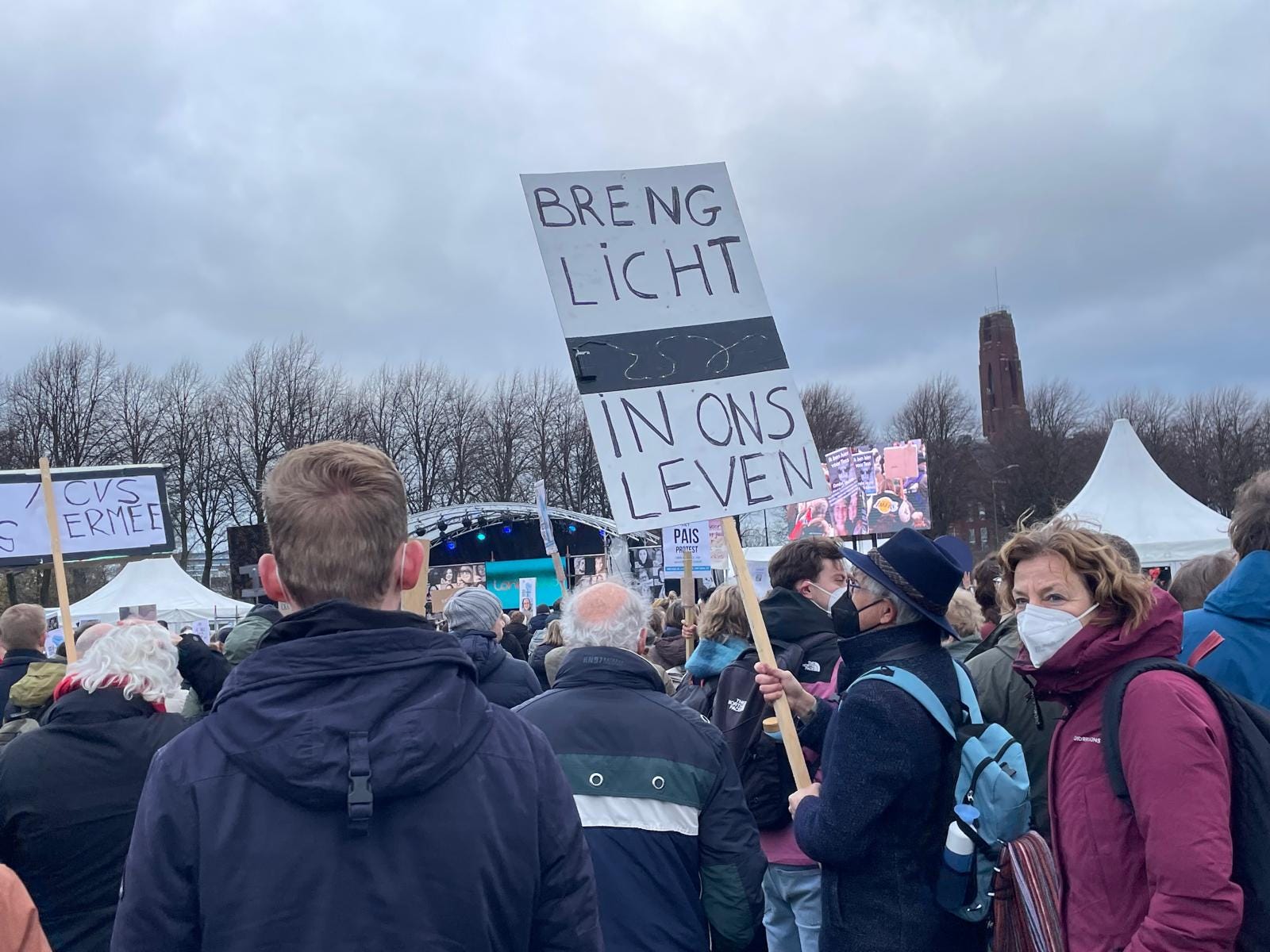
A peaceful protest
I walk to the Malieveld in The Hague. A procession can be seen on the light grey path that leads to it. There are white tents on the field that have nothing to do with the protest. They are the tents of Cirque du Soleil. In addition, there is a modest crowd, which grows denser toward the stage.
I make my way forward and take in the audience. I see people with walking sticks and folding chairs, but also people with strollers and protest signs. “Not psychological, but phyZical,” it says on one of the signs.
The stage is empty. In the first two rows behind the crowd-control barriers sit people in wheelchairs with blankets over their legs. Directly behind them begins the standing crowd; apparently many parents and family members of the sick. Most of them are wearing face masks. They are all facing the stage. Modern piano music comes from the large speakers next to the stage. On a screen, the minutes are counted down until the live program begins.
I make eye contact with a few middle-aged women. They all have red, wet eyes. A man with a large nose sobs soundlessly with a fist against his forehead. More and more signs rise above the crowd. “Bring light into our lives,” it says. Or: “I am sick, not tired!”
The sky, which was sunny this morning, has filled with grey clouds. It is bitterly cold. People sway back and forth on their legs to keep warm.
The moderator is a woman in a wheelchair. She has very long straight hair. She is here today for her mother, who has PAIS. Why she does not state the reason for her own disability. She says she is a feminist and an activist. She has a high, piercing voice. She is proud that we have all come and asks us to wear a face mask. I pull my scarf up over my chin.
The first speaker comes onto the stage. She stands there with a number of A4 sheets in her hand. Today she speaks about her daughter, who has had ME for almost ten years.
The woman tells, loudly shouting, in practiced sentences with pauses in between, about the situation her daughter lives in. She can only speak to her in a whisper, in a dark room, where she hides all day. The outside world is dangerous for her, because everything, even impressions or thoughts, can worsen her symptoms. “I miss my daughter, even though she is still here!” the woman shouts. “And her loneliness is deeper than I can imagine!” Around me I hear people sniffing. In front of me a man awkwardly brings his hand to the back of the woman standing next to him. Between their torsos a distance of ten centimeters remains. They briefly look at each other, their eyes dark and shiny above their face masks. “Her shoes stand in the room like a memory! Her bicycle stands symbolically in the shed!” the woman shouts. Her voice trembles with anger and grief. In all these years there has been no improvement in her daughter’s condition. There has been no medical breakthrough and not even better care. “But thank God now finally there is… euthanasia!” The woman looks over the crowd, her small, sinewy body with square shoulders completely tense, her arms tight against her body as if bracing herself. “Hooray!” she shouts sarcastically. The crowd is silent. “We are going to lose my daughter,” she concludes the speech. “We have already lost her.”
There is applause. The moderator in the wheelchair appears again. The crowd is asked to make a fist with their right hand. Everyone raises their fist. There is no chanting or shouting.
An ethicist appears on the stage. She says that her profession is to concern herself with good and evil. In her work she focuses on the question of PAIS. She says that a physiological solution must be found for the diseases and suggests that such a solution could have existed long ago. She speaks of a shadow pandemic of chronically ill people. She says that our future is dark, because due to rising temperatures on earth, more and more infectious diseases will come our way, all of which can lead to PAIS. She calls the lack of attention to PAIS the greatest medical scandal of recent decades. “Hear hear!” someone shouts.
The moderator gets the floor again. “Everyone… can get PAIS…” she says. “You get it through pure bad luck.’’
There is a family that has brought a wheelchair with a doll in it. They stand around it, so that from a distance it is hard to see whether there is a real person sitting in it. “Did you make this?” I ask, as I stand in front of it. The doll represents a person who has been sick for 1156 days. It is written on a cardboard sign attached to the doll’s legs. “Yes,” nods a blonde woman in her thirties resignedly. “Bizarre, right.”
Two people remain standing silently next to each other while the rest of the crowd disperses toward the station. They clutch in their hands two cardboard-cut silhouettes with names on them. “Is this for your loved ones?” I ask. The people seem frozen. “Certainly,” the man says, and he stubbornly keeps staring straight ahead, as if he is trying hard not to see me.
I talk to a kind woman with blond hair. She is a General Practitioner. She has Long Covid herself, but she could still manage to come to the protest. She tries to explain something medical to me, but says it is hard for her to reproduce when she is suffering from brain fog, like she is now. Behind her a group of her colleagues get together to take a group picture. ‘I also made mistakes in the beginning,’ the woman says, ‘because when someone is tired… yes… as a docter, I tell them to try out activity. But now that I have it, I know this is not the way.’
My friend with Long Covid tried to watch the live stream of the protest, but could not bear it. He found it too depressing and it made him despodent. On the train I write him a long message about how I experienced the protest.
It felt like a funeral service and it was horrifying, it was hell. These people portray themselves as the living dead and their death is also their only weapon… they seem to want to threaten with it. In their faces you see hatred and fear. “We do not want to disappear!” they say. “We may not be torn from life!” And yet it happens. Photos were shown of people in bed, hiding beneath blankets with sleep masks on their eyes.
No one knows the solution to the diseases and an appeal is made to the authorities. Their assignment is to discover a remedy. At the protest only indignation remains, and within it you feel powerlessness, toward the institutions and toward nature. And suddenly you get the image of a humanity living in a dark cave, abandoned by science.
And while you stand there it ultimately feels as if you are praying to God, praying that a holy genius will arise who finds the solution. But no one there can be that, or thinks that he is.
Hell and damnation are preached but you can do nothing about it because it is real, it is their fate. They try to warn you about this injustice, of which you did not know before that it existed.
I felt the world narrowing in that fear. But now I breathe out in relief. As if I have barely escaped the grip of that shadow world.
My friend says that he sees the protest as something purely instrumental; an impulse added to the lobby for his cause. He sends me a mass by Josquin that he listens to in his dark room. The piece begins with two male voices that intertwine with each other. “When I listen to this I almost need no one anymore,” he writes. I imagine his room as an empty cave.
Arguably the worst part about post-viral fatigue is how much of an unserious condition it is to the average person, especially when you verbalize it in mundane, not scientific terms and because of the social media reputation that long COVID has gotten thanks to paranoid liberals and cynical conservatives.
I got it after a bad bad case of food poisoning in late 2024 and it has lingered on, mostly due to comorbities, albeit with decaying intensity due to my management and I suppose some sort of internal timer.
I was pleasantly surprised to find this post (or any) not making fun of chronic fatigue syndrome/symptoms.